


Introduction
For complete transparency, at the time of writing this article, I don’t have access to Microsoft Copilot’s latest feature, Autopilot [Introducing the new Copilot with Home, Code and Autopilot – The Official Microsoft Blog] or Copilot Studio’s Persistent Agents [Delegate shared business processes to agents that are more persistent and proactive | Microsoft Copilot Blog], which allow for AI Teammates. However, I know they are coming, and I have been thinking, “How can I prepare for it?”
So, this article is me sharing my thinking (and, to be honest, the thinking of my Copilot companion as well).
Before we go into that thinking we better explain what Copilot Autopilot.
What is Copilot Autopilot?
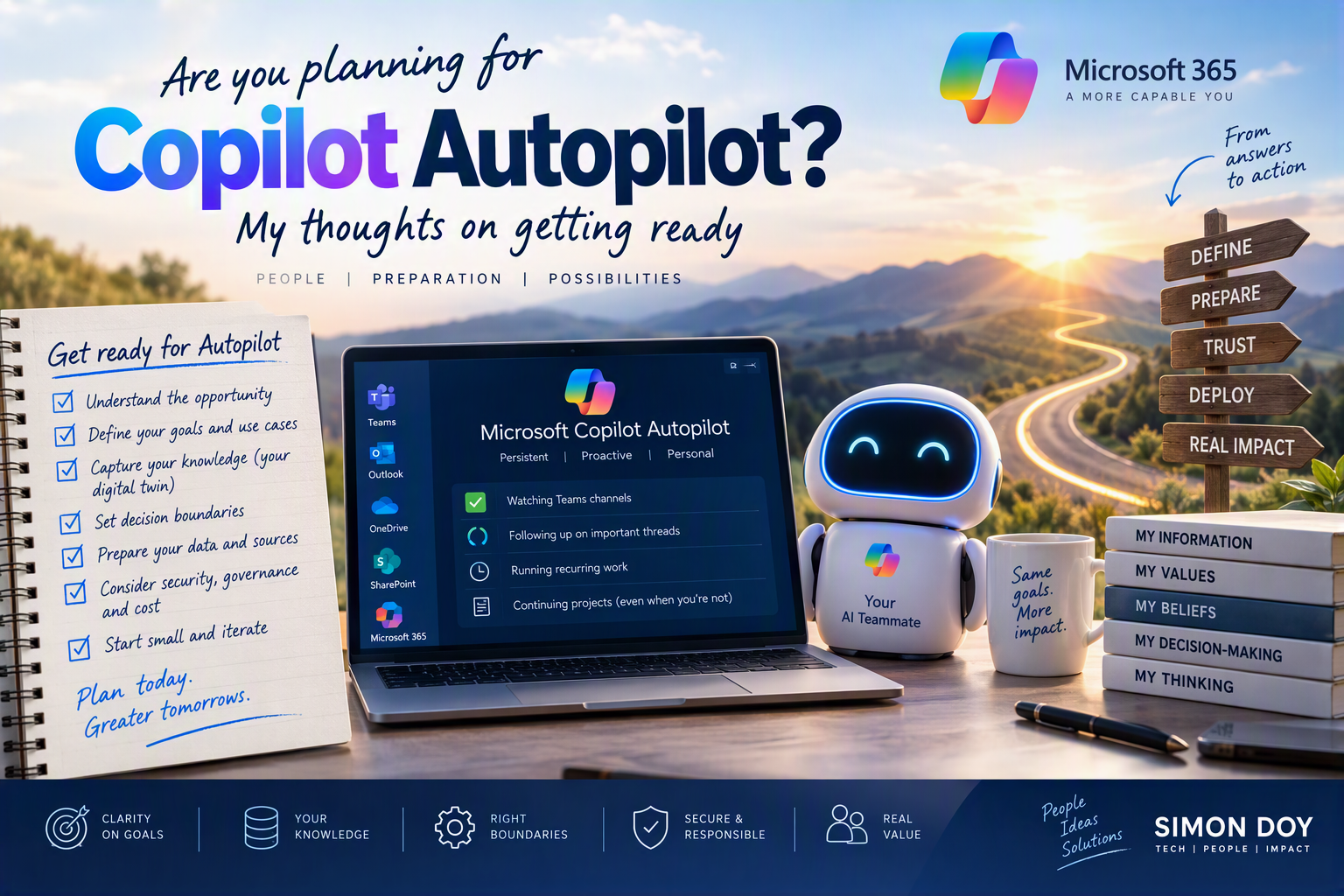
Well, Copilot writes that Autopilot moves Copilot from answering requests towards working proactively on a continuing objective. Microsoft describes it as a “persistent, proactive and personal agent that keeps working even when you’re not”.
Think of the difference like this:
- Chat: you ask a question or request a draft.
- Cowork: you delegate a task to be completed.
- Autopilot: you give an agent an ongoing role and goal, with boundaries for its work. Microsoft’s announcement describes Chat and Cowork; reporting on Autopilot describes this role-and-goal model.
Reported examples include watching Microsoft Teams channels, following up on chat threads, running recurring work and resuming a project days later. The agent has its own identity, memory and workspace within your Microsoft 365 environment.
So Autopilot is Microsoft’s version of Grokbot, Dot, Muse and Openclaw. It is the evolution of Microsoft Scout but with one big difference in that it is running in the cloud.
I have the understanding that you can have multiple Autopilots which you name and assign yourself as their manager. This allows for autonomous AI capability which has a specific purpose or role.
One thing to point out is that they are part of the usage-based billing (UBB), so you are going to be paying as you go.
Anyway, the one use case that I am interested in is having an agent that understands me and can support me during my day, a digital twin.
So, what about Autopilot’s digital twin capability?
So, we can have an Autopilot that is a “digital twin” and acts and behaves how we would. Imagine having an agent that you automatically answers those low-risk questions and decisions and then routes the important, riskier or that require additional thought to you to respond too.
Honestly, I think it sounds amazing but also scary.
So, if I or we wanted to have such a capability, what would we need to do to make this happen? I guess this is where my thinking is. If I want to have such a thing, what do I need to do so that it understands me?
This does remind me of one of my favourite teen movies, Weird Science, where the characters, Wyatt and Gary, make a girl (Kelly LeBrock) with their computer, and they fill the computer with knowledge and images until they blow up their computer and house… classic!
Anyway, so, how do we fill our Autopilot with knowledge on us?
Well, we need to think about what makes us. This is probably a bit too much for this blog post, but it takes me back to my days with my business coach and the identity iceberg.
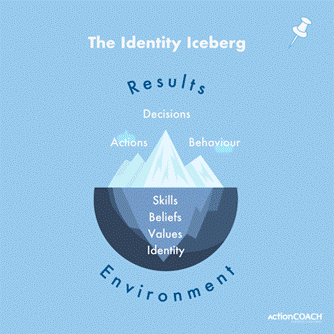
This is what I was thinking about when coming up with a set of information to support an autopilot acting as a digital twin. The idea is that your decisions, actions and behaviour are based on your skills, beliefs, values and ultimately your identity which is made up of these parts.
You can change and evolve but as you move further down the iceberg it becomes harder to do as they are based on lots of different aspects including your parents, environment, upbringing, values and beliefs. However, that being said, you can modify these things to allow you to change and get the results that you are looking to achieve. It’s a very powerful idea and very liberating if you are looking to achieve something that you might not be sure you can do…
So based on the identity iceberg and taking the ideas a bit further, we need to collate the following to build a picture of what makes us, us. So, we need to build out information in the following areas.
| Area | What to make explicit |
| Information | Authoritative sources, current commitments and outdated material. |
| Values | Principles that should guide actions, especially when priorities conflict. |
| Beliefs | Working assumptions, supporting evidence and what would change your mind. |
| Decision-making | Criteria, trade-offs, acceptable risks and approval boundaries. |
| Thinking | Examples of decisions, the alternatives considered and why you chose them. |
What can you do to get ready?
So, we have some areas which we need to delve into and provide to our Autopilot. This will generate our own personal Knowledge Base, which we can hook into our Autopilot.
As I mentioned earlier, we need to be able to have our Autopilot make decisions as to what it can and can’t handle. I believe that these choices should be part of that Decision-making area. Here we should add what we are happy for our Autopilot to decide on and where it should route the discussion to us. I would suggest that we have a whitelist of things to allow at the start.
Examples might be recommending iThink 365 products and services to colleagues. Approving expense receipts under £150 and approving holiday (however, really, we want to have a skill which we can provide to the Autopilot to detail the process of approving leave. For example, checking who else is off, whether they have got enough leave, and whether they are taking too much time etc.)
The decision-making process of what to include, how it will work, and how good it will be is interesting, and we will have to wait until Autopilot is launched before we can see.
However, either way, this personal knowledge base is going to be very powerful and generate this wealth of knowledge for our Autopilot.
How do we collect this information?
The next step and question are: how do we collate and pull all this information together?
Well, of course, I started a dialogue with Copilot on this.
I think the most obvious way would be by being interviewed and going through a series of questions on each of the areas mentioned earlier.
Ultimately, I can see a series of skills being built to form those questions. Maybe based on Matt Pocock’s Grill Me (Grillwith docs) skill. By using Copilot to ask the questions and record the answers, we can build up this corpus of knowledge.
I do have a list of questions which I have been working on; I am still working on these, but here are some to get you thinking. I will, as my confidence in the approach builds, share more of them.
Identity: Who is Simon?
Create a relatively stable Simon Profile that establishes role, responsibilities, expertise and personal context.
- How would you describe yourself?
- What is your role at iThink 365?
- What responsibilities do you personally own?
- What responsibilities do you delegate?
- What are you accountable for as CEO?
- What are the most important outcomes you are trying to achieve?
- What areas are you genuinely expert in?
- What areas do you know reasonably well?
- What areas should the Copilot never pretend you are an expert in?
- What companies, products, technologies and communities are important to you?
- What does a good working week look like?
- What personal priorities affect how you organise your time?
How Simon thinks
This is more valuable than biography alone. The twin needs to recognise the reasoning patterns behind decisions, not merely reproduce previous answers.
Decision-making questions
- When you make a decision, what information do you want first?
- Do you prefer evidence, experience, instinct or a combination?
- What makes you sceptical about an idea?
- What makes you enthusiastic about something?
- What risks do you naturally worry about?
- What risks are you comfortable accepting?
- When do you want more evidence before committing?
- When is “good enough” genuinely good enough?
- What makes you change your mind?
- How do you deal with conflicting evidence?
- What would cause you to stop a project?
Scenario questions
A customer asks for something technically possible but commercially poor. What would you consider?
Microsoft technology could solve a problem, but a much simpler solution exists. Which way would you lean?
A proposal is 90% complete, but the deadline is tomorrow. Do you ship it or keep improving it?
A customer asks for an AI solution where you do not think AI is the answer. What do you do?
Scenario answers reveal trade-offs, thresholds and judgement. They are often more useful than a simple list of preferences.
How Simon communicates
Communication should be captured by context. An email, LinkedIn post, technical document and proposal should not all sound the same, even when they share the same underlying voice.
- How should an email from you sound?
- How should a LinkedIn post sound?
- How should a technical document sound?
- How should a proposal sound?
- What phrases do you naturally use?
- What phrases would you never use?
- How formal and direct are you?
- How do you disagree without sounding confrontational?
- How do you give bad news?
- How do you apologise?
- How do you chase somebody who has not responded?
- What makes you read something and immediately think, “That does not sound like me”?
Some of these questions are about capturing anti-patterns as well as preferred patterns. Knowing what Simon would never say is just as important as storing examples of what he would say.
How Simon works
This section I find interesting, as I do have a prescriptive way of working and a routine with a rhythm to it. I can see there will be a lot of value in having an Autopilot help me in all of this. Also, I can imagine that this might not be to everyone’s taste, and the list below is probably too Microsoft 365-focused for everyone’s tastes.
Daily operating rhythm
- How do you start the working day?
- What do you check first?
- How do you prioritise email?
- Which messages deserve an immediate response?
- Which items become Planner tasks?
- When does something belong in the calendar?
- What do you tend to procrastinate on?
- What should Copilot proactively remind you about?
Weekly and monthly rhythm
Capture recurring reviews for projects, customers, finances, invoicing, expenses, cash, sales pipeline, utilisation, marketing and business development.
If I disappeared for a week, what routine activities would someone have to perform to keep Simon’s world running?
Preferences and defaults
Small defaults materially affect trust and usefulness. They should be stored explicitly instead of rediscovered on every task.
- UK English and product-name conventions
- Preferred document structure, tone and level of detail
- Use of tables, headings and formatting
- Meeting preferences and working hours
- Travel preferences
- Preferred channel by scenario, such as Teams or email
- Preferred suppliers, tools or products
- Things that irritate you in documents or communications
As I mentioned, there are many more questions, but I am still working through them. The one thing that Copilot is great at, is coming up with questions!
However, for them to be useful, you have to be able to answer them! Sometimes those questions are too simplistic, or vague or too difficult to be able to give an answer that I would be useful.
Summary
In this article, I have shared my excitement about Microsoft Autopilot and how I think it will be helpful to us. However, I believe that for it to be useful, we need to give it a lot of information, and that will take energy and effort. Without that energy and effort, we will only get small gains, and for it to be truly transformational, we need to put effort into it.
So, in this article I have started to share my thinking about what is involved and needed and how we can prepare. At least then this will give you something to do whilst we wait for Autopilot to arrive!
It might be that I am completely wrong, and so if that is the case, well, sorry about that, but I would love to hear your thoughts and how you are preparing. What questions do you think we need to ask and answer for our digital twins?
I’ll continue to share my thoughts and approach, and hopefully we can work together to unlock the potential of Autopilot and digital twins. I guess time will tell.

