This image is an illustration of a leader sharing some information with their team.

Improving my approach: Using AI to Documenting Solution Designs for Development Teams


As we prepare for the next release of SmartFlo, I wanted to share a way that I use SmartFlo to help me get things done.

It has always been interesting and a challenge to be the person who leads the discussion with the customer and what they are looking for in terms of having a business process transformed or a system built for them. The most important part following the discussion is communicating with the development team on approach, pitfalls, and ideas. This often falls to the solution architect or business owner, who has to effectively communicate what they are looking for, design approaches, etc, to the development teams.

In this role, I explain what it is that we are building and why. I will pretty much always do some research, provide guidance as to how to do things, and what to watch out for so that the team are going to be taking a successful approach and hopefully not get blocked.

As part of this process, I need to explain how and the expectations of what the customer wants. Additionally, there are often a lot of other factors which make up what different stakeholders are looking for, and those will have been discussed with the pre-sales team. It is important that those discussion points are handed over successfully so that the delivery teams build the right thing.

Nine times out of ten, it comes down to communication and ensuring that the design and intention is clearly communicated and, most importantly, written down.

This allows the Dev team to ingest the design and approach in their own time and in a repeatable way.

Recently, I have been using SmartFlo to help me capture this information in a consistent and well-structured way.

The SmartFlo template that I have created has the following sections to capture the important information, such as security considerations, number of users, data size, areas of risk, concerns and more.

So why don’t we delve into what the template looks like and the process of creating this content?

To create the document, I simply have a meeting with myself and/or another member of the team, and we talk through the solution.

We talk through how we expect it to be built. We include what is being built and why. We talk about pitfalls and areas of concern. We really delve into the details so we can get as much information recorded in that meeting.

I then finish the meeting and run SmartFlo. This will create the document, which is then reviewed by me. I make any necessary updates, and then it’s ready to share with the team for feedback.

Here is an example of the output
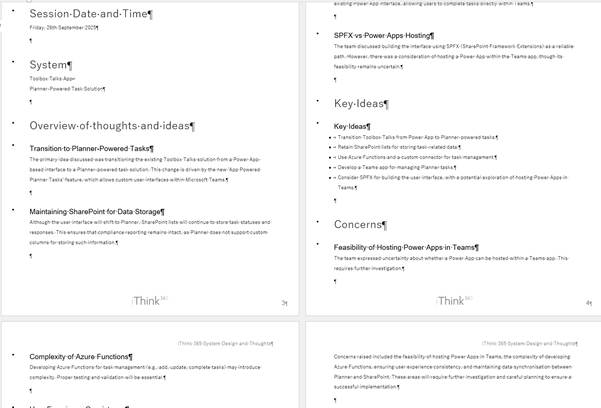
Over time of using this process, the template has been refined further to help pick out areas which need their own section. Such as authentication or what licenses are required.

SmartFlo has dramatically reduced the time taken to write these documents, but it has also helped to improve the quality and consistency of what is produced.

Now with SmartFlo, what used to take 90 -120 minutes to write now takes 20-30 minutes!

Creating the template

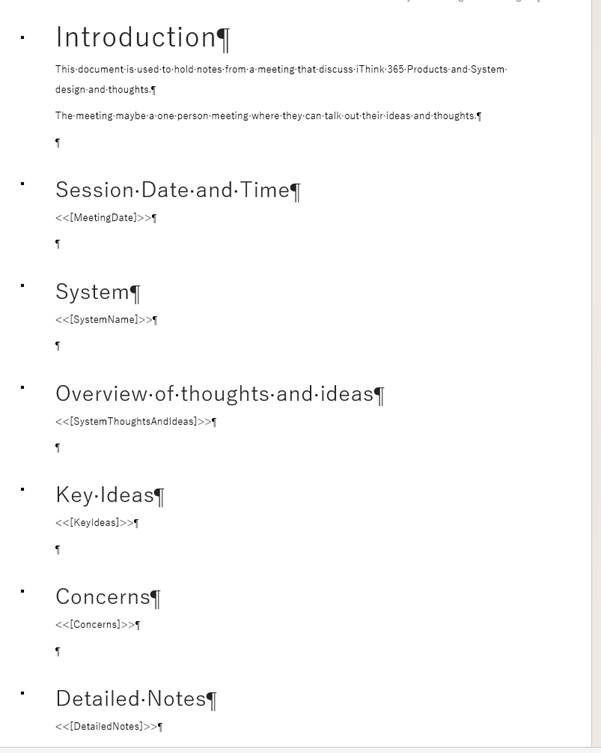
Creating the SmartFlo template is straightforward. We take our standard company-branded template and create some sections to record the key information.

You can see this below.
We upload the template into SmartFlo and then use the following to describe the template.
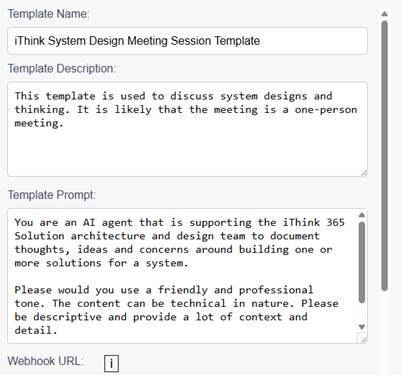
For each of the sections, we tell SmartFlo how to fill out the template.
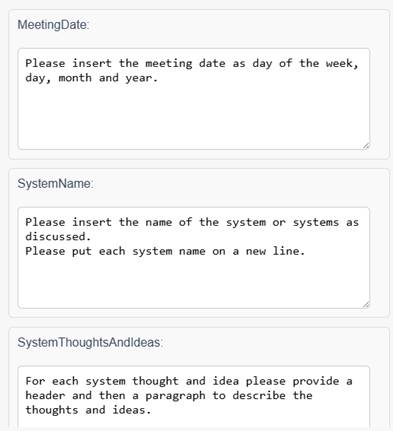
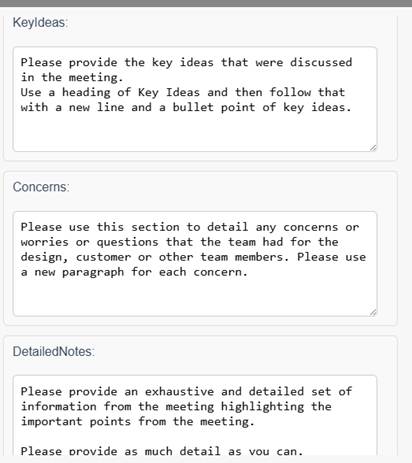
That is it, there is some good detail in the template and getting that right can take a couple of attempts, but it’s incredibly quick and easy to get one of these templates out.

What do you think?

I would love for you to benefit from tools such as this and improve how you get things done. To help, you can install and try out SmartFlo, by getting started and signing up for a 7-day trial.

Please let us know what you think!


Enable Marketing to keep ahead of the curve with Microsoft Lists


Photo by Geran de Klerk on Unsplash

Introduction

At iThink 365, we are Microsoft 365 specialists, it is essential that we keep up to date with all the announcements from Microsoft and the community in and around the Microsoft 365 and Microsoft Azure platform.

The Marketing team used to spend hours a week collating the information from the various blog posts and identifying those that we should interact with, whether that is to respond to, reshare, or provide our point of view on.

Microsoft uses the Microsoft Tech Community to publish an extensive set of blogs. There are approximately a hundred blogs that are updated every week, keeping on top of them is time-consuming and labour-intensive.

A solution was needed, how could we bring all the content from the blogs automatically and enable someone to review the content to identify themes in contact that the Marketing team would want to work with.

After some thought, Microsoft Lists with some automation from the Power Platform seemed like the match made in heaven.

In this article we will discuss how we used Microsoft Lists to help resolve the challenges mentioned above additionally, the solution has been in place for several months and there are some other advantages to having the solution in Microsoft Lists which will be discussed shortly.

Video Guide

    Video guide to enabling Marketing to keep ahead of the curve with Microsoft Lists.

    Microsoft Lists to the rescue

    So how did Microsoft Lists become the solution to our challenge? Well, Microsoft Lists provides us a way of storing structured information from the blog posts into unique fields for each post.

    If you look at a blog post it has information such as:

    • Blog post title
    • Publish date
    • Host blog name
    • Content
    • Post URL

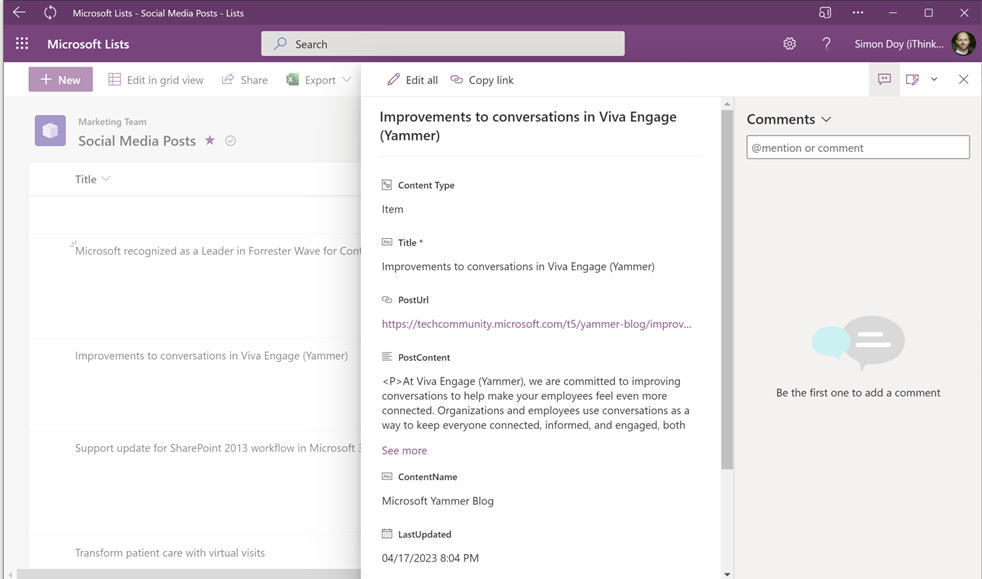
    We wanted to be able to capture that information and store each piece of information in a column with a similar name. So, we built a Microsoft List which had the following columns:

    • Title
    • PostUrl
    • PostContent

    Etc.

    In the screenshot above you can see an example of one of the list items being open. Because Microsoft Lists is being used, there is the ability to comment and discuss each of these posts. This is great as it allows us to quickly start a conversation with the Marketing team and discuss or highlight a specific post that we should be working with.

    Having Microsoft Lists to hold this information is great but how do we get the information into the Microsoft list in the first place?

    Collating information into Microsoft Lists

    The approach to getting information into the Microsoft Lists is by using Power Automate and a fantastic technology that has been around for a while called RSS (Real syndication service) Feeds.

    Using Power Automate, a list of RSS feeds is provided to Power Automate to be checked each day. Power Automate loops through each of the RSS feeds and for each feed pulls down the last 20 posts. Each post is checked to see if has already been added to the Microsoft List. If it has not, then a new entry is generated, and the information is added to the appropriate columns.

    The Power Automate did take some time to write but it runs in a minute or so and the result is an updated list with new entries since the last time it ran.

    That is all there is to it!

    The benefits

    Now that we have the Microsoft List for all the social posts, it has several benefits, some which were planned for and others which were a byproduct of pulling the information into Microsoft 365 and Microsoft Lists.

    Firstly, the main benefit is we have a central location which has all the latest posts pulled into one place and makes the consumption and reading of these blog posts easy. As there is also a link to the original post, we can use that to delve into the post for more information if we want.

    Secondly, using the comments features the Marketing team can discuss ideas and highlight those posts which are most interesting to us.

    Thirdly, now that this information is in Microsoft Lists, it gets picked up by Microsoft 365 search and often the teams find themselves searching for a feature or technology and one of these posts is returned. These posts often link to useful resources which the team can use to find out more!

    Accessible anytime and anywhere

    As I write this post from the airport in Frankfurt after the MVP Summit, I can access the Microsoft list through my Android mobile app and the Microsoft Lists Progress Web Application (PWA) application. Which makes it even easier to consume, update and discuss these social media posts.

    Conclusion

    Using Microsoft Lists has really helped our Marketing teams keep a grip on the latest and greatest from Microsoft. They have helped us put in place a central storage location and a great place to hold conversations and comments in the context of those social media posts.

    All of this helps us keep our customers up to date with the information that we think they should need. It also helps us to keep ahead of the curve by looking to the future and being able to react to the latest and greatest news from Microsoft.